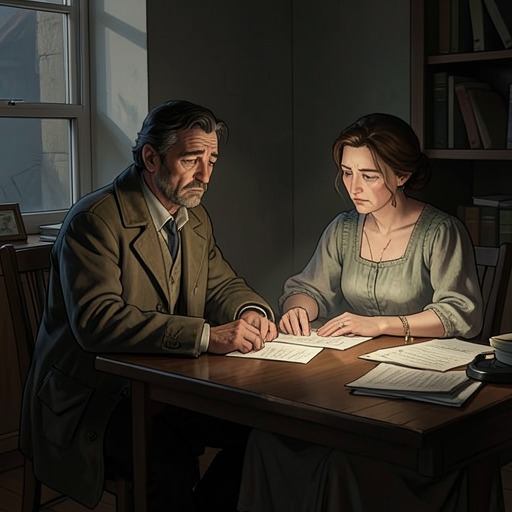
Josef Mengele—Martha Mengele
The Disappearance of Josef MengeleJosef Mengele’s marriage to Martha joined family-business calculation to a relationship that, in the book’s account, became personally important to him. His father saw the marriage as a way to secure the family’s control of the company, while Josef came to describe Martha as a source of renewal and companionship. When his flight from justice made ordinary family life increasingly precarious, that bond was tested by distance, danger, and disagreement over where the family could live.
A marriage proposed as family strategy
The plan took shape after Josef’s divorce from Irene was finalized in Düsseldorf on 25 March 1954. Karl Sr welcomed the divorce, but his interest extended beyond his son’s private life. Martha, the widow of Josef’s younger brother Karl Jr, was destined to inherit her late husband’s shares in the family business. Karl Sr feared that if she married the foreigner she loved, that man might gain a place on the company’s board. He therefore proposed that Josef marry Martha, keeping the business within the family.
The proposed arrangement also had a practical purpose tied to Josef’s status as a fugitive. Karl Sr suggested that Josef could give his shares to Martha after the marriage, so that an arrest warrant would not paralyze the company. Even then, the plan left Josef in control: his father expected him to direct Martha’s decisions on the board. The marriage was thus conceived not simply as a new household, but as a means of managing inheritance, corporate authority, and the risk of prosecution.
Josef embraced the scheme partly for its personal and vindictive implications. He imagined Irene’s anger when she learned he had remarried, especially because his new wife was Martha, whom Irene loathed. He was also drawn to the fact that Martha was Karl Jr’s widow, treating the match as a way of asserting himself against his dead brother. The narrative presents that possessive rivalry alongside the business arrangement, without suggesting that Martha’s own aims were the same as the men’s.
The meeting in Switzerland
Karl Sr arranged a meeting in the Swiss Alps, organizing travel and accommodation and arranging for Rolf to accompany Martha. The meeting also meant that Josef would encounter his son, who had been told as a child that his father died in combat in Russia shortly after his birth. At Hotel Engel in Engelberg, Martha arrived with Rolf and her son Karl-Heinz; the boys were both twelve. She introduced Josef to the children as Uncle Fritz from America, maintaining his assumed identity while the adults met.
Josef quickly assessed Martha in terms of his own preferences and rivalry with Irene. He believed she had character and firm convictions, and noted that the boys obeyed her and that she was a committed Nazi and caring mother. He also regarded her as a woman unlike his former wife, and resolved not to compare them. The account makes clear that his perspective was controlling and self-centered: he interpreted the marriage through his own desires, his judgments about women, and his resentment of Karl Jr. His sense of triumph over his brother accompanied the couple’s beginning, rather than disappearing once the marriage became a household.
Marriage, travel, and shared life
Josef and Martha married privately in Nueva Helvecia, Uruguay, on 25 July 1958. Karl-Heinz, Rudel, and Sedlmeier served as witnesses. Friends and associates attended, while Karl Sr, who was ill, remained in Günzburg. After the meal, the newlyweds left for Bariloche, entrusting their son to Haase for the journey. Their wedding was therefore both an intimate family occasion and part of a wider network of associates who helped sustain Josef’s life under an assumed identity.
The honeymoon unsettled Josef’s expectations. He had not thought he could tolerate another woman’s company, yet he found Martha patient and receptive to his extended conversations about history and intellectual figures. He described her as bringing him a renewed sense of youth and desire. In Buenos Aires he gave her a house by the ocean at a seaside resort. These details mark a change in his account of the relationship: Martha was no longer only the widow selected in a family plan, but someone whose presence he valued and with whom he could imagine a settled domestic life.
That domestic prospect depended on circumstances that the marriage could not control. After the arrest warrant was issued in Freiburg im Breisgau in February 1959 and extradition requests began moving between Germany, Argentina, and Paraguay, Josef left Argentina for Paraguay. Martha and Karl-Heinz initially remained behind. The separation was a direct consequence of the threat of arrest and the uncertainty of whether Argentina would continue to shelter him; Josef told them they would meet soon in Asunción.
Exile and separation
The move exposed a difference between Josef’s expectations of fugitive life and Martha’s experience of it. In Paraguay, he imagined rebuilding a household with her and Karl-Heinz, buying land, and settling down once he secured citizenship. Martha, however, struggled with the heat, power cuts, red dust, and the repeated moves and hotel stays. She complained about his absences and worried about Karl-Heinz’s education. She wanted him to return to Buenos Aires, where she believed they could be happy as before. Her objections make the marriage’s limits visible: Josef’s pursuit of security required concealment and mobility, while Martha sought a more stable home for herself and her son.
By early 1960 the couple was meeting again. Martha stayed with Karl-Heinz in Vicente López, and later they met Josef at the Hotel Tirol in Encarnación, where Sedlmeier joined them. They discussed money, communications, and the development of their Paraguayan company. Josef showed his partner photographs of a property he hoped to buy in the Alto Paraná region. Martha had, by then, accepted the possibility of following him into exile, and he returned to Krug’s farm reassured and nearly happy. The planned property and business suggested a renewed attempt to make family life compatible with flight.
That attempt ended when the pursuit intensified. In September 1960, with Mossad monitoring the movements of Martha and Karl-Heinz and nearing Krug’s farm, Josef decided he had to disappear again. He and Martha had to separate; she and Karl-Heinz returned to Europe without saying goodbye. The marriage had begun as a device for preserving family property and had developed into a relationship Josef claimed to value, but the conditions of his evasion finally overruled the household he hoped to maintain.